
Last year, I read a series of short stories by Jorge Luis Borges and my favourite was “Tlön, Uqbar, Orbis Tertius”. This story has two separate parts, and in both a book describes a mysterious location. In the first, the country of Uqbar is detailed in a single encyclopedia chapter and the narrator attempts to find out more information from other sources, to no avail. The Uqbar chapter contains references to unfamiliar names and places. This reminded me of the footnotes used in the novel Jonathon Strange & Mr Norrel by Suzanna Clark. These provide background information, independent of the main story, about magic. The footnotes refer to fictional magicians’ scholastic works, sometimes in turn referencing previous footnotes. I really like this concept of taking something fantastic, and making it appear real by describing it in a more non-fiction way, such as in an encyclopedia or through a bibliography.
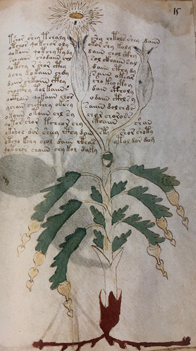
There are examples of this within several strange real-world manuscripts. These weird books are often written in unknown or imaginary languages that have proven indecipherable. Many turn out to be hoaxes.
Probably the most famous example is the Voynich manuscript. It was found in 1912 by a Polish bookseller at a Jesuit college in Italy. This book has been radio-carbon dated to the early 1400’s and unlike the medieval manuscripts you might imagine, it is not a large leather-bound book brightly illuminated with gold. Instead, it is small and made of simple vellum (animal hide) that would have been inexpensive at the time. The manuscript contains many bizarre illustrations, almost one per page. Most of these are drawings of real and imaginary plants. But there are also many images of women in baths and various zodiac-like wheel diagrams. The book also contains several fold-out pages with larger illustrations. The presence of the diagrams has resulted in many theories about where the manuscript came from, such as from Roger Bacon, the English scientist; or John Dee, the occultist. However, neither of these two are likely candidates as the carbon-dating indicates the manuscript is too old.
What is also interesting about the Voynich manuscript is that it is entirely written in an unknown language and alphabet that has defied all attempts at decoding so far. Many have tried, and there are theories that it is a known language written in cypher, or was developed by scholars for a language that had not yet been written down. However, the words could also be nonsense and the document a hoax designed to be sold to a gullible buyer.
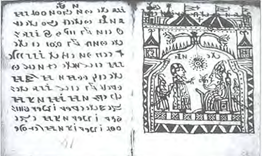
Two other mysterious books are actually considered hoaxes. One is the Oera Linda Book, supposedly written in Old Frisian, an old Germanic language. It details a mythical history that starts in 2194 BC with the sinking of Atland (Atlantis). It was likely made in the 1800s and intended to fool people. Another hoax is the Rohonc Codex, and like the Voynich manuscript, it is written in an unknown language and alphabet. It also contains many child-like drawings of soldiers, priests and castle scenes. It is believed that the manuscript was composed by a Hungarian conman who created and sold many other forgeries.
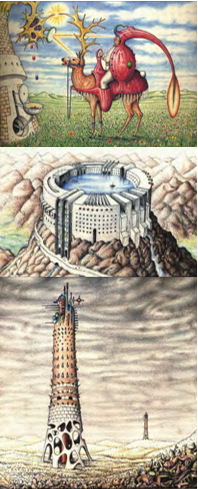
Books like this may not be made to swindle people. The use of an unknown language, strange alphabets and dreamlike imagery could also be done purely for aesthetic purposes. The Codex Seraphinianus is one such book. Its author did not make it to con medieval pilgrims and it doesn’t explain how to summon angels or find lost kingdoms. This book was a surrealist project created in the 1970s by Italian artist Luigi Serafini. The book is designed to appear like an encyclopedia. This makes it like the one in the second part of the Borges story mentioned above, which reviews an encyclopedia on the world of Tlön. The Codex is divided into a series of chapters that appear to cover the plant-life, animals, science, history, and cultural life of an imaginary world. The writing is imaginary, and the book is full of many pictures that resemble stuff out of dreams. My favourites are the architectural drawings in the last chapter. The Codex Seraphinianus is an interesting artistic piece but the pictures are perhaps too surreal to make the reader think that they show real concepts, unlike the Voynich manuscript and Rohonc Codex.
Imagine finding one of these weird books and trying to determine what it means, especially if it was written in an understandable language and referenced real-world names and places. This is why I think Borges’ Uqbar story, where someone finds a non-fiction document that presents strange information, is so fascinating. It has given me some ideas for a story of my own.