
A senior scientist stands before a crowd, giving a lecture on his latest discovery to members of the public. A second one sits at dinner party with new friends. With martini in hand, he finishes explaining what he does for a living. Another one, perhaps a younger graduate student, tells her family members why she chose to work in a laboratory all day. All three of these scientists may experience the same tight knot in their stomach as they anticipate the dreaded but always popular follow-up question: “Why bother to study that?”.
Usually, the expected answer is something like “we’re trying to develop a new drug”, “we want to explore new treatments for this disease”, “we want to stop agricultural pests”, or other real-world technological applications of the scientific results. This is often the case when the scientist is directly involved in applied research, especially clinical trials and healthcare-related topics. However, these applications are less obvious when the scientist is studying something more esoteric like deep space nebulae, marine invertebrate lifecycles, or the movement of seemingly random cells in a small organism.
Frequently, at their core, a scientist is simply driven to pursue knowledge for knowledge’s sake, but this noble goal is often snorted at and receives comments referring to “a waste of tax dollars”. These pursuits fall within the realm of basic science, which seeks to improve the understanding of, and more importantly, predict natural phenomena. While the applications of this are not always clear at the outset, it is no less important. It can still have very far-reaching outcomes. I think the one of the best examples of this is the discovery of Green Fluorescent Protein.
The Jellyfish’s Secret
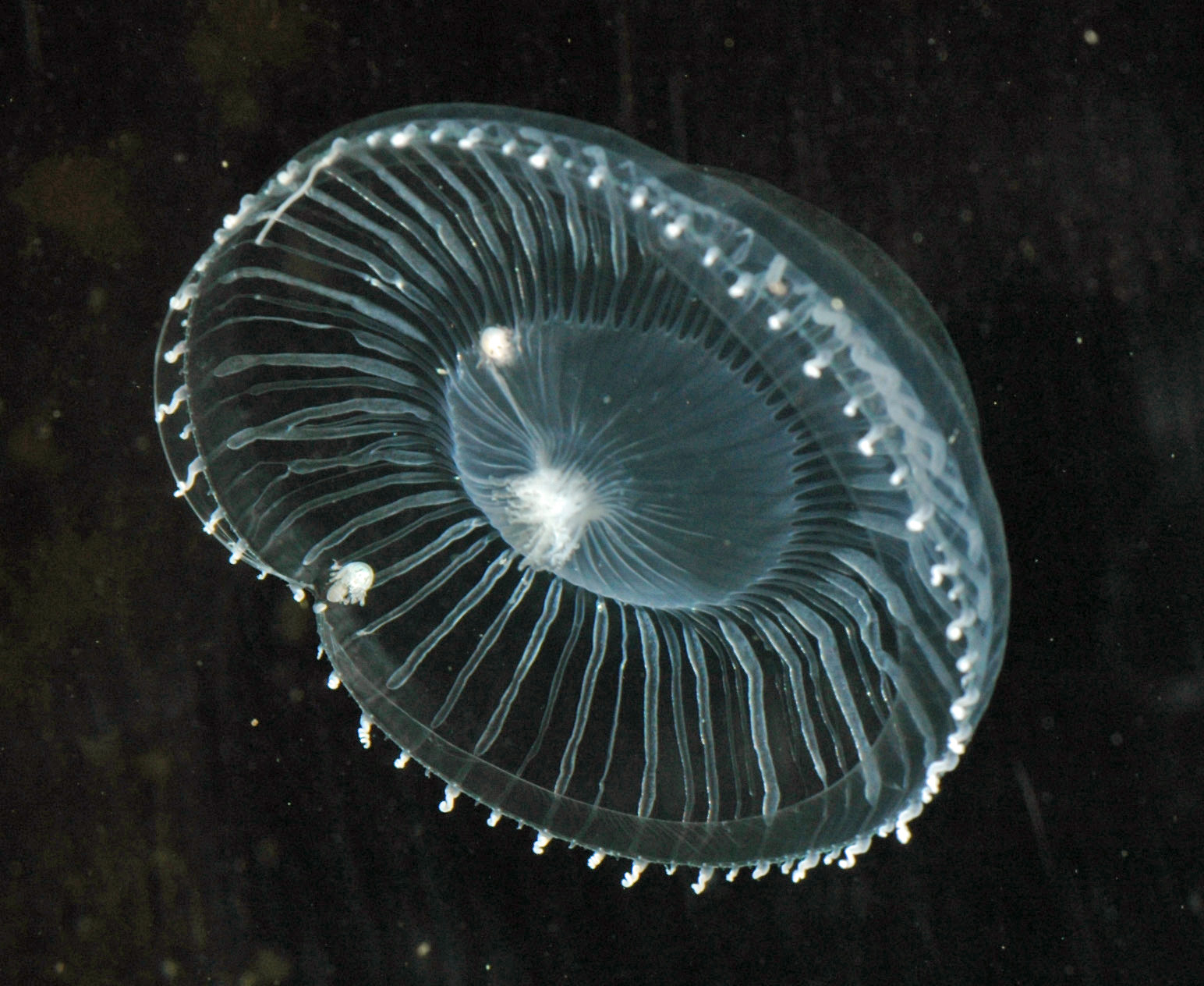
Let us rewind to 1962, when a young biochemist, Osamu Shimomura, set out to work on an interesting project. The young man already had an interesting story. He grew up in Imperial Japan and was present when the Fat Man atomic bomb was dropped on Nagasaki. Osamu survived the blast, the fallout, and the radiation sickness before getting an education. Now he was in America, studying why a species of jellyfish, Aequorea Victoria was able to glow in the dark. Osamu purified the responsible proteins from the jellyfish’s transparent body and studied their properties. One of these was Green Fluorescent Protein, otherwise known as GFP. The second protein interacts with Calcium to glow blue, and some of the energy is transferred to GFP to induce the colour green.
A Valuable Tool
The Jellyfish’s use of proteins for bioluminescence was certainly a novel accomplishment for basic science. But its true importance would not be known until the 1990s when basic science was able to build upon Osamu’s earlier discovery.
Exactly 30 years later, Douglas Prasher’s lab identified the DNA sequence used by jellyfish cells to produce GFP. However, he could not continue with the project and instead gave his materials and expertise to two other independent scientists: Martin Chalfie and Roger Tsien. These two were able to show why a strange gene from a jellyfish could be so important to other scientists: as a reporter gene.
Reporter genes are used to show another gene, the actual topic of study, is being expressed and causing proteins to be made within a cell. Proteins are invisible when cells are viewed under a microscope, but if a gene’s DNA sequence is fused to a GFP DNA sequence, the resulting protein will be fused to GFP and therefore glow in the dark. Additionally, the GFP-fused protein often remains functional in live organisms, allowing scientists to observe its movement within a cell and better understand what its function actually is. Many such reporter genes require the addition of co-factors to work, but GFP does not. This makes GFP relatively easy to use to study poorly understood genes. GFP can also be expressed in all the cells of a specific type through a variety of techniques. This allows for scientists to directly observe the development of a tissue, limb, or even an entire organism.
A Nobel-Prize Winning Discovery
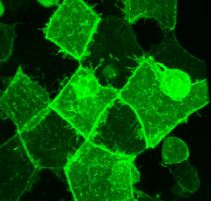
The development of several GFP derivatives has allowed for multiple reporter colours such as red, yellow, and cyan. These derivatives allow for the expression and behaviour of multiple proteins to be observed and compared at the same time. The use of GFP and other fluorescent proteins as reporter genes has made possible countless breakthroughs in different areas of biology. In medical research, their use has directly allowed for the observation of nerves and spreading cancer cells. I used these same techniques in my own work studying the behaviour of moving cell layers in zebrafish embryos; and many other scientists, in both applied research and basic science projects, use the techniques in their investigations too.
For their discovery and pioneering of GFP, Osamu Shimomura, Martin Chalfie and Roger Tsien were awarded the Nobel Prize in 2008. All the later discoveries built upon those early investigations into what made a jellyfish glow in the dark.
A Chronic Underestimation of Basic Science
It was not until 30 years after the initial discovery of GFP for the its biotechnological use to be realized. And in the 30 years since, it has played an integral part in the study of cells, animal development, and medicine. It is probably one of the most important tools used by biologists today. Yet, it almost didn’t happen. This is tied directly with what happened to Douglas Prasher. He was the first person to suggest GFP’s use as a reporter gene when he determined its gene sequence. Unfortunately, his lab lost funding, eventually forcing him to leave scientific research entirely and become a bus driver.
Many of the applications that come out of basic science take years to fully develop. When they do, they can be totally surprising, even to the original researchers. Scientific research is often a complicated long game, with funding largely depending on how well a scientist can write a grant and explain why their work will have a future impact. If they cannot do this adequately, funding often dries up, and the work will stop with scientific projects left unfinished and potentially world-changing phenomena left undiscovered.
This almost happened with Douglas Prasher’s GFP work, and it likely would have happened if he hadn’t sent his work to other scientists on his way out. How many other Douglas Prasher’s are out there, and how many GFPs lie in a forgotten notebook on some dusty shelf? It is crucial for scientists to be able to explain why their work is interesting. It is also important to ask why a certain phenomenon is being studied, and what a scientist hopes to gain from it. However, it is also important to realize that is not always very clear. Later, other scientists may take the discovery in other new, exciting, and possibly world-changing directions, just like with GFP. It is this process that makes basic science so valuable, and why its importance should be hammered home.
Subscribe to my mailing list for updates on new content.