
The classic example of metamorphosis is the butterfly. The butterfly larva, or caterpillar, resembles a small worm with multiple short, fat legs; and a traditional classroom activity was to put one in a jar and watch it transform into the colourful, winged adult butterfly. The magic of the butterfly metamorphosis is that is happens out of site, after the caterpillar wraps itself in a cocoon of its own self-spun silk. It almost seems like a trick performed by a stage magician: a rabbit is placed in a locked box or goes behind a curtain; the magician performs some maneuver to distract the audience, and finally, a beautiful assistant is revealed to dazzle them.
However, metamorphosis in other species is often just as interesting to watch. You may have observed the changes tadpoles undergo as they grow into adult frogs: absorbing their tales and growing legs and arms in their place. Yet, the frog’s metamorphosis is not as dramatic as the radical body transformation a caterpillar undergoes.

It is in the sea that one can find some of the most bizarre examples of metamorphosis. For example, take the jellyfish. In one stage of its life, it almost looks like some weird plant from a sci-fi story. It has a long stalk attached to the ocean floor, making it immobile, and tentacles at the top. This structure, called a polyp, will replicate and form a colony of many similar polyps. Each of these will eventually bud off tiny baby jellyfish when they are ready to move on to the next stage of the life cycle. Imagine for a second, a small plant that takes over an entire field, before finally flowering and turning into multiple clones of identical miniature humans. That is loosely analogous to the life of a jellyfish. Another weird example is the tunicate. Its tadpole-resembling larva burrows its face into the sand, loses its tail, and then transforms its head into something totally different!
One of my favourite examples of metamorphosis is that of the sea urchin. They look like balls covered in thin spines. You have probably seen them at aquariums or maybe even eaten one at a fancy restaurant. However, what I found very surprising when I first learned it, is that that spiny ball is only the adult form. Sea urchins also have larvae, and they look absolutely nothing like the adults. They are best observed under a microscope. They have a body compartment where their gut and mouth are located, and multiple leg-like structures. They’ve always reminded me of the tripods from the War of the Worlds movie.
The sea urchin larvae will consume algae as it grows. They will gradually grow a small organ, called a rudiment, to the left of their gut. This structure will grow larger within the body compartment, until the larva is ready to undergo metamorphosis. The exact cue is unknown, but it may be influenced by nutrient levels in the environment, and the thyroid hormone chemical is also known to be involved. Regardless of the cue, when metamorphosis happens, the rudiment will literally burst from the side of the larva’s body, and the body compartment itself is absorbed or discarded. If you’ve seen the movie Alien, its almost like the famous scene where the creature erupts from the man’s stomach. This final act of the metamorphosis is dramatic and occurs in minutes or over a few hours. The result is a tiny baby sea urchin, in the form we expect. During the process, when the adult sea urchin is born, you can even see the first tiny spines peaking out of the larval body compartment.
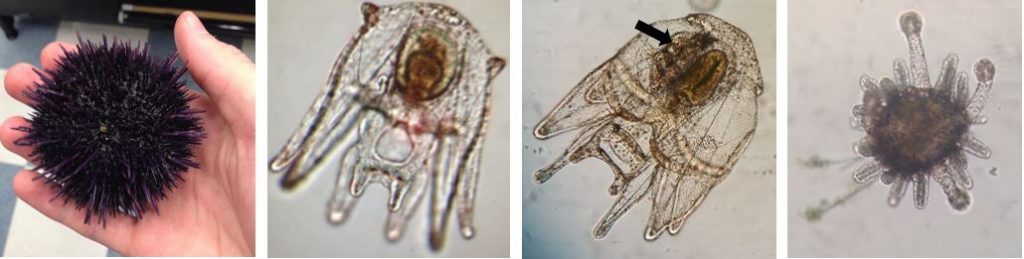
There are many interesting questions about metamorphosis that have not been fully answered by scientists. What is the role of the thyroid hormone chemicals? Why do they seem to have a role in all organisms that undergo metamorphosis, from sea dollars to newts and fish? There is also the phenomenon of retro-morphogenesis, where the metamorphosis process is not irreversible. For example, some jellyfish develop backwards into the polyp stage. Another invertebrate, bryozoans, develop similarly to sea urchins and have been observed to completely resorb their rudiment and then grow it again.
Marine invertebrate metamorphosis can sometimes seem to be the stuff of nightmares, or as I have already made analogy to, science fiction. Examples of the body horror genre directly incorporate metamorphosis, such as David Cronenberg’s move The Fly. But other bizarre and strange things found in nature can also inspire new elements of science fiction. The glow-in-the-dark fauna in the Avatar movie looks like something found in the deepest crevices of the ocean, along with bioluminescent angler fish, king crabs and tube-worms. Indeed, the deep sea can seem like another world. Yet, it can also be used as a guide for what other real worlds might be like, and not just literary ones. Carl Sagan imagined that life on Jupiter might resemble jellyfish. Scientists today believe that if there is complex life in the oceans of Jupiter and Saturn’s moons, it could like something found near our oceans’ hydrothermal vents.
Subscribe to my mailing list for updates on new content.