
In biology, mutations are the driving force for evolution. Mutations typically result in the loss of a gene’s proper function. Yet, they may also lead to new and interesting uses for a gene’s proteins. What matters is if the mutation confers some advantage to the individual organism. If this means the organism is more likely to survive and later reproduce. When that happens, the mutation is also replicated, passed on to offspring and will increase in the population over time.
We often think of these advantages in terms of sexual selection – ex. extra colourful feathers allowing birds to find mates easier – or helping to survive a harsh environment – ex. warm fur to protect against the cold. However, mutations can also help by making organisms more resistant to diseases. The classic example of this relates to malaria.
Life of a Malarial Parasite
Malaria is not caused by bacteria or viruses. Instead, it is due to an animal parasite with a complicated lifecycle involving the infection of humans and mosquitoes. Let us start with the mosquito. The parasite starts life as a gametocyte in the blood of infected hosts. First, female mosquitoes ingest these gametocytes when sucking the blood of these hosts. The males and females will mate within the mosquito and produce the malarial sporozoite form. Later, the sporozoite will migrate to the mosquito’s salivary glands. The next time the mosquito feeds on an uninfected human, the parasite is released.
Once within a human host, the parasite migrates to the liver. Here, they grow and multiply, before infecting red blood cells. They multiple again within the red blood cells, a process which causes the cells to rupture and release the parasitic contents back into the blood stream. These daughter parasites will then infect new red blood cells. At this point, the human host begins to show disease symptoms. They can also now pass on the parasite to any mosquito that bites them. Here is an excellent diagram of this complicated life cycle.
Three Types of Malaria
There are multiple species of the malaria parasite. Three are Plasmodium falciparum, Plasmodium vivax, and Plasmodium ovale. While each of these can infect humans, they also have slightly different characteristics. For example, P. vivax and P. ovale can become dormant in liver cells before later activating and infecting the red blood cells. For this reason, human hosts can sometimes relapse months or years after the initial infection! The other species, P. falciparum, causes the most severe infections. Furthermore, some of its strains have developed resistance to malarial drugs. This species is most common in Sub-Saharan Africa.
HbS Hemoglobin: A Useful Mutation
A key part of the malarial life cycle occurs in red blood cells. Thus, genetic traits affecting the red blood cells will have effects on how well malaria can infect a host. The classic example is the sickle cell gene.
Hemoglobin is the molecule within red blood cells that allows them to carry oxygen. In normal humans, there are three types: Hemoglobin A and A2, and hemoglobin F. Hemoglobin F is the main type in newborn infants, afterwards Hemoglobin A and A2 are the main types.
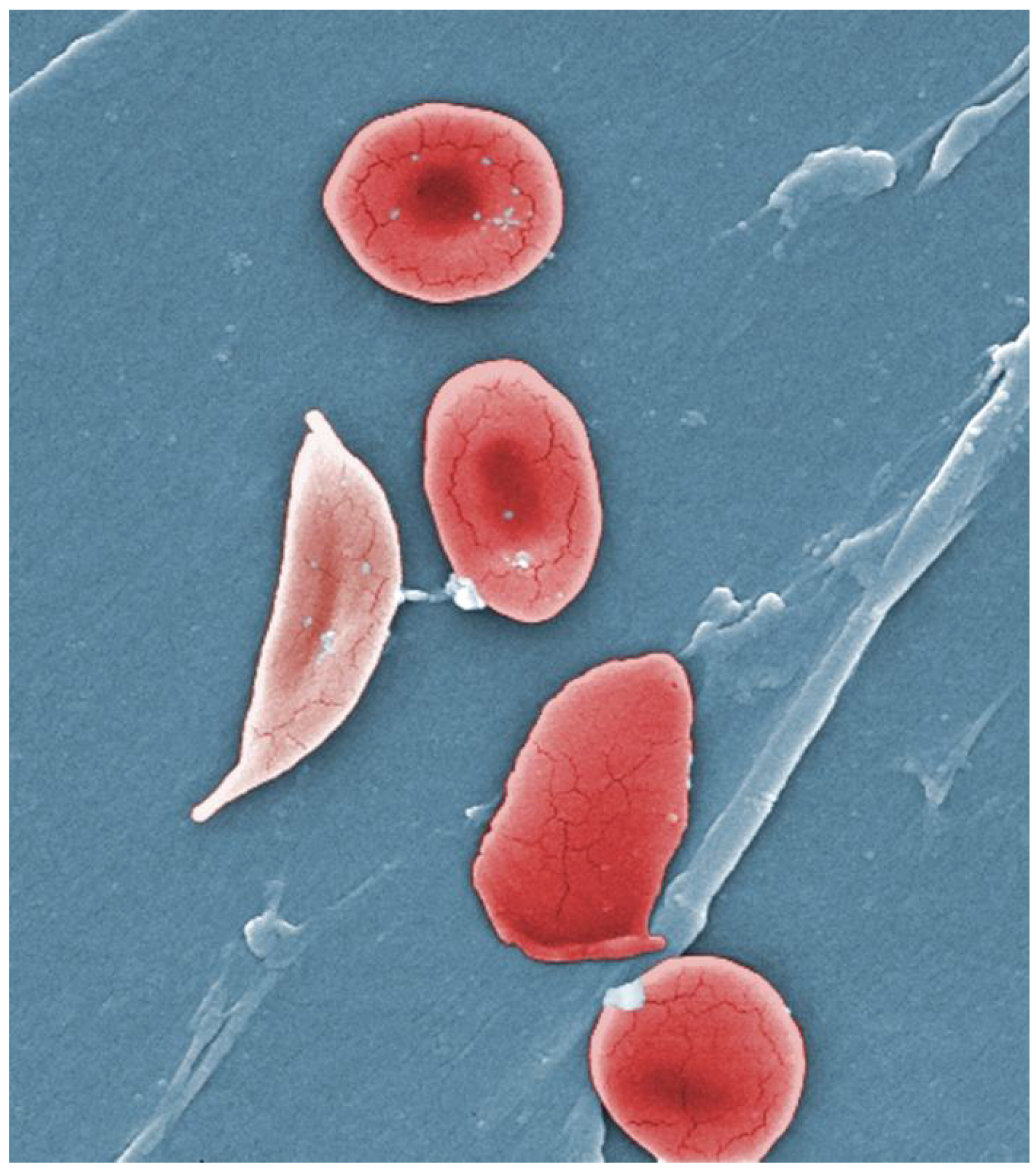
Individuals with the sickle cell gene have an altered component of the Hemoglobin A protein. This results in a new type, Hemoglobin S (HbS). Normally, red blood cells are very flexible. They need to be, as bending and twisting allows them to move through narrow capillaries. Yet, when exposed to low levels of oxygen or tight crowding of cells, HbS molecules form long chains. This causes the red blood cell to take on a curved sickle shape. Hence the trait’s name “sickle cell”.
These sickle cells do not respond to the malarial parasites in the same way as normal red blood cells. When the parasites attach to them, the cells rupture. In this way, the sickle cells prevent the key multiplication step of malaria, thwarting the infection. Also, if the parasite cannot infect the red blood cells, they will not be passed on to any pesky mosquitoes, and thus, other humans.
Providing an Advantage
Malaria has a very high mortality. Therefore, there is a high degree of selective pressure on any trait that could reduce this. This means that such a mutation within a population suffering from malaria will provide a strong advantage, allowing for those who carry it to survive longer and reproduce more. In the real world, this situation occurs in Sub-Saharan areas where malaria caused by P.falciparum is widespread. Here, sickle cell provides malarial resistance and therefore increases in prevalence over time. This is why the sickle cell trait is more commonly found among people of Sub-Saharan descent.
Technically, this favouring of traits within the population should occur for any trait that provides resistant to malaria. Indeed, this is the case. Similar selective pressures exist for the genetic mutations that cause thalassemia and glucose-6-phosphate dehydrogenase deficiency. Again, these traits are more common in P. falciparum-malaria endemic areas. Another mutation, where blood cells lack a particular type of antigen (a protein located on the outside of the blood cell), prevents the infection of P.vivax.
Too Much of a Good Thing
While sickle cell provides resistance to malaria, it can also come with a significant trade-off. The sickle-shaped red blood cells are poor at conducting oxygen around the body and do not circulate through the blood vessels as freely. This may not necessarily be an issue. What matters is if the individual with the trait is homozygous or heterozygous.
Every gene comes in a pair of copies, called alleles. When you have two alleles for a specific genetic trait, you are said to be homozygous, if you only have one allele the term is heterozygous. Sometimes for the trait to be expressed by the individual organism, only one allele is needed. Sometimes two are required. This is where the terms dominant and recessive come from, respectively. However, in some cases, one allele will provide a level of expression and a second allele will serve to increase it. This means that heterozygous individuals will show a trait and homozygous individuals will express it more severely. An example of this is sickle cell.
Heterozygous individuals will not have all their blood cells affected. Since they still have a normal allele, a sufficient level of normal red blood cells will remain to easily transport oxygen throughout the body. In this way, heterozygous people will gain the malarial resistance benefit of the mutated HbS but will not experience most of the drawbacks. In fact, the only time heterozygotes show sickle cell disease symptoms is if they are in situations with lower oxygen overall, such as mountain climbing.
Two alleles for sickle cell creates its own set of problems. In this case, all red blood cells are effected, and the poorer transport of oxygen will subsequently cause a variety of health complications. As this genetic trait is present at birth, sickle cell disease symptoms start early in life, typically at 5-6 months. People with the disease can expect a life expectancy of 40-60 years in developed countries. Essentially, they are suffering from too much HbS.
Excess Baggage
Overall, being heterozygous for sickle cell can offer the advantage of malarial resistance. However, note that it is only an advantage when malaria is a disease that the individual could get. It provides no real value if there is no chance of contracting malaria in the first place. In fact, if this happens, sickle cell can even be a disadvantage for the population at large.
Such a situation occurs among African Americans of Sub-Saharan descent in the modern world. Today, malaria is not common in North America (and many other places too). However, heterozygous individuals, who have the sickle cell trait but not the disease symptoms, still carry the genes. This means they can still pass them on to their offspring. If two parents are carriers, their children may become homozygotes and suffer from sickle cell disease. This situation, where the advantage of a trait is no longer present, but the potential consequence of having it is, is termed “evolutionary baggage”. What may have been useful for ancestors is instead detrimental to their descendants.
In this way, sickle cell illustrates an important point to remember about mutations. They can be advantageous or disadvantageous. They can also come with trade-offs. But this is not necessarily constant throughout time. For one generation, a mutation could make an organism more “fit”. While for a later one, it may do exactly the opposite.
Subscribe to my mailing list for updates on new content.