
While incorrect, the idea of a flat earth could be intuitive. If you find yourself outside, say in a large open field or on top of a hill, look around you. From such a vantage point, the world simply appears flat. As the world stretches away in all directions you can easily imagine a large flat disc with the sky rising above you. Without any other knowledge, this simple idea would seem so obvious that you wouldn’t even question it. Therefore, it shouldn’t be particularly shocking that many cultures throughout history have imagined the earth as a flat. Usually, this was in the form of a single flat disc surrounded by sea with the sky forming a dome above.

However, what I find more striking, is the prevalence of a much more complicated cosmology, what I like to call “the pancake earth”. Here, the world is imagined not as a flat disc. Instead, it is series of discs, all layered on top of each other, like a nice stack of pancakes. Our world is simply one of these layers, with other worlds in other layers.
In such systems, the earth is only one of the pancakes, with heavens arranged above and chthonic underworlds below. For example, the Icelandic Prose Edda describes three layers of heaven: Asgard, Andlang, and Vidblain; with other realms beneath the earth. In Asia, the Ainu of Japan believed in six skies, and various Siberian tribes imagine layers too. There are many more examples and my own index is not complete. Perhaps the most extreme were the Aztecs and Maya who had a grand total of 13 heavens and 9 underworlds all stacked together. One of the earliest references to a pancake earth can be found in the ancient Egyptian Coffin Texts (Spell 957). These date to approximately 4000 years ago, and refer to upper, lower, and middle skies. Similarly old, Sumerian prayer incantations reference seven heavens and seven earths.
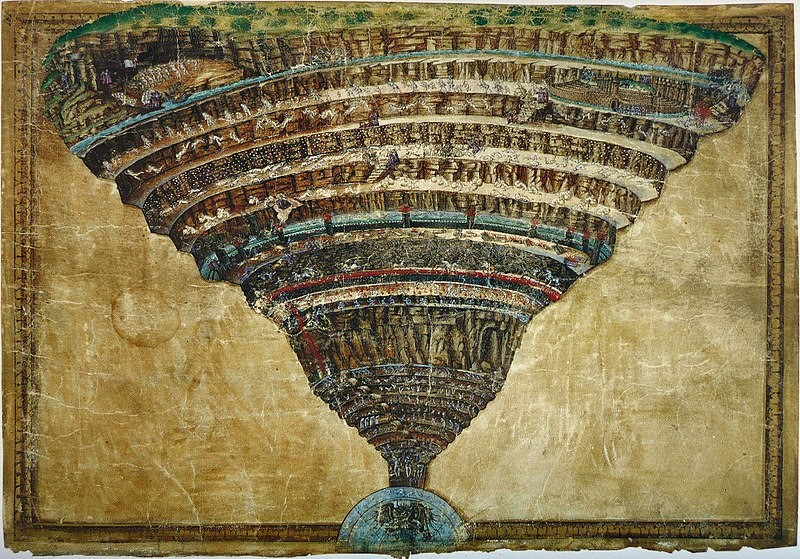
The use of the words “heaven” and “underworld” could be viewed as indicating that the different layers are different destinations once in the afterlife. This is sometimes the case, but the layers can also be geographic locations that are inhabited. Returning to the Norse sagas; gods, humans, and giants each inhabit their own layer world. They are often able to travel between them, even by such easy means as walking! In other cultures’ tales, such transport may occur via a rope, vine, thread or chain of arrows. In Maori myth, the demi-god Tawhaki climbs up a vine to the highest of 10 heavens before starting a family with a lady he meets there.
What Could This Mean?
It is certainly interesting that so many different cultures have developed this similar layered cosmology. A further question is how this may have occurred. Did they develop this idea on their own, based on what they saw in the world around them? Did they inherit the idea from other peoples, sharing it with each other and adding their own modifications? As I mentioned earlier, the Earth as a flat disc can be easily imagined when looking in all directions. But the idea of multiple earths and heavens, all layered on top of each other, with transport possible between them, is very complicated. This sophistication could suggest some level of cultural borrowing and descent. For example, wheels and iron-smelting were invented only in a few distinct places, but these inventions were able to spread across the globe over time. Might diffusion also explain the prevalence of the pancake earth?
Funny enough, many years ago I had a conversation about pancake earths with my sister, who was 7 or 8 at the time. My family was going to take a plane to go on vacation, and during our conversation, I realized that my sister had assumed the world was made up of a series of flat discs and the sky was just the bottom of the one above us. She thought that we were going to ride the plane up to the next layer and have our vacation there! A very bizarre idea but one that is not unlike the ones I’ve discussed above. But, how could a little girl have imagined this detailed cosmology with presumably no input? The pancake earth idea is not commonly found in our world today (in fact it was almost impossible for me to find some suitable images on Google). Thus, she was likely not told about it. If anything, she was told the world was round. Instead, I think this anecdote suggests that something about the pancake earth idea could be intuitive. I do not mean universal though, as the pancake earth is not present in all cultures. In an almost dream-like way it can be imagined by both early societies and young children. Perhaps, instead of being a complicated idea dispersed from a single common origin, the pancake earth may be an example of parallel evolution.
There are many examples of similarities between different cultures’ myths, such as world trees, adventuring horse twins, and even weapon-wielding thunder gods battling against serpentine enemies. Some were obviously borrowed by neighbouring cultures. The origins of others, because they are more separated in time and space, are much murkier and more mysterious. In general, there are two schools of thought. First, that the parallels show remnants of older tales, maybe from an ur-mythology that was modified by subsequent generations. Alternatively, they are intuitive ways of describing the world based on common ways of observing what is around us. These are not necessarily mutually exclusive and depend on the comparison made. In the future, I will explore these theories and other parallel examples like the pancake earth.
Subscribe to my mailing list for updates on new content.